When you compare dry cleaning machines, the purchase price is the figure on the quote. It is not the only figure that matters. Energy, solvent, water, labour and maintenance time keep arriving long after the machine is installed, and for many shops they matter as much as the price you paid. This post sets out the running costs to think about, the questions to put to any supplier, and what Firbimatic says about how its Energy Saving and Saver machines are designed to keep those costs down.
Where running costs come from
No two machines cost the same to run. Before you compare quotes, list the places where money and time go each week.
- Energy. Electricity for the machine itself, plus whatever heat it needs for drying and for cleaning the solvent. Some machines need a separate steam supply or extra electric heating installed. Others are designed to manage without.
- Solvent. How much is used for each load, how it is purified so it can be used again, and how often it needs topping up.
- Water. Some cycles use water. Ask how much, and what that adds to your bills.
- Labour. How much attention each load needs, and how easy the programs are for your staff to run.
- Maintenance time. Filters, routine cleaning and servicing all take time, and a machine that is out of action is not earning anything.
Questions to ask any supplier
A good supplier will be happy to answer these, ideally in writing and for the exact model you are considering.
- What services does the machine need on site, such as steam, extra heating or water connections?
- How is the solvent purified, and which filters or parts are replaced as part of normal use?
- How much water does a typical cycle use?
- Where do the energy and water figures come from, and what were they compared against?
- How much floor space does the machine need, and what does installation involve?
- Which routine tasks fall to your staff each day and each week?
- Who will service the machine, and how do you get parts?
What Firbimatic says about its Energy Saving series
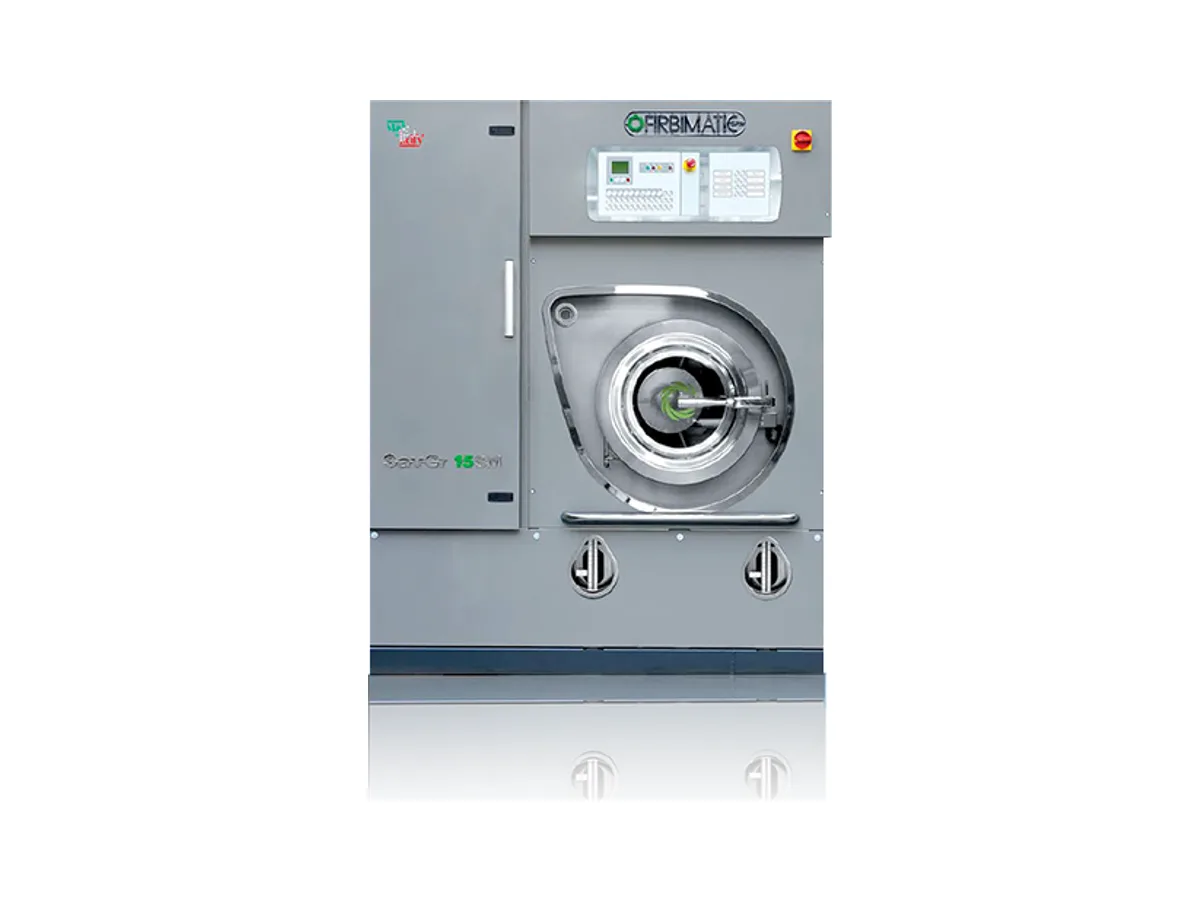
Firbimatic offers an Energy Saving series in two load capacities, 10 and 15 kg. Firbimatic describes the design like this:
- Reinforced thermal insulation around the basket, the drum and the drying tunnel, to limit heat loss.
- A first wash bath that uses slightly preheated solvent, heated using the condenser of the heat pump and applied as a fine spray (nebulisation). Firbimatic says this means less solvent and less energy.
- A short distillation, because only a small amount of solvent is involved.
- Drying in two stages, with the heat pump dividing its effort equally between heating (50%) and cooling (50%).
- A heat pump that runs on R 134a refrigerant and, according to Firbimatic, can reach the temperature needed for drying with no extra boiler.
Firbimatic states that tests show these machines match conventional machines for cleaning, while delivering savings in energy of up to 50 percent. It also states that each cycle needs 65-70% less water, compared with a conventional machine.
What Firbimatic says about the Saver line
Firbimatic's Saver line is built for alternative solvents of the Class III aliphatic type, and its main running-cost idea is to do without conventional distillation. Instead, the solvent is purified by filtration: one nylon powder filter, one cartridge filter and a decanter fitted with self-drying. Firbimatic states that this lowers operating time, electricity use and maintenance.
Saver is also designed to be self-sufficient. Firbimatic says it does not need a steam supply from outside or additional electric heating, because its condensation and heating system runs without drawing on outside water or energy. The aim is simpler connections and a lower utility bill.
The line comes in narrow (ST2) and wide (LT2) versions with load capacities from 10 kg to 25 kg. Firbimatic describes Saver as suited to small and medium-sized laundries, pointing to its compact size, simple operation and low running costs. Firbimatic describes the Saver savings in general terms rather than with a percentage. You can read more on the Saver page.
Check the numbers for your own shop
The figures above are Firbimatic's own. The words "up to" describe the best result in its tests, not a promise for every shop. Your results will depend on the model, the garments you handle, how many loads you run and what you pay for energy and water.
Before you rely on any saving, please check the numbers for the model you are considering by contacting Spencer Systems, the exclusive Australian distributor of Firbimatic machines. Put the same questions to any other supplier you are comparing, and set the answers side by side.
If you would like running costs set out clearly for the machines on your shortlist, get in touch with Spencer Systems or request a quote.