

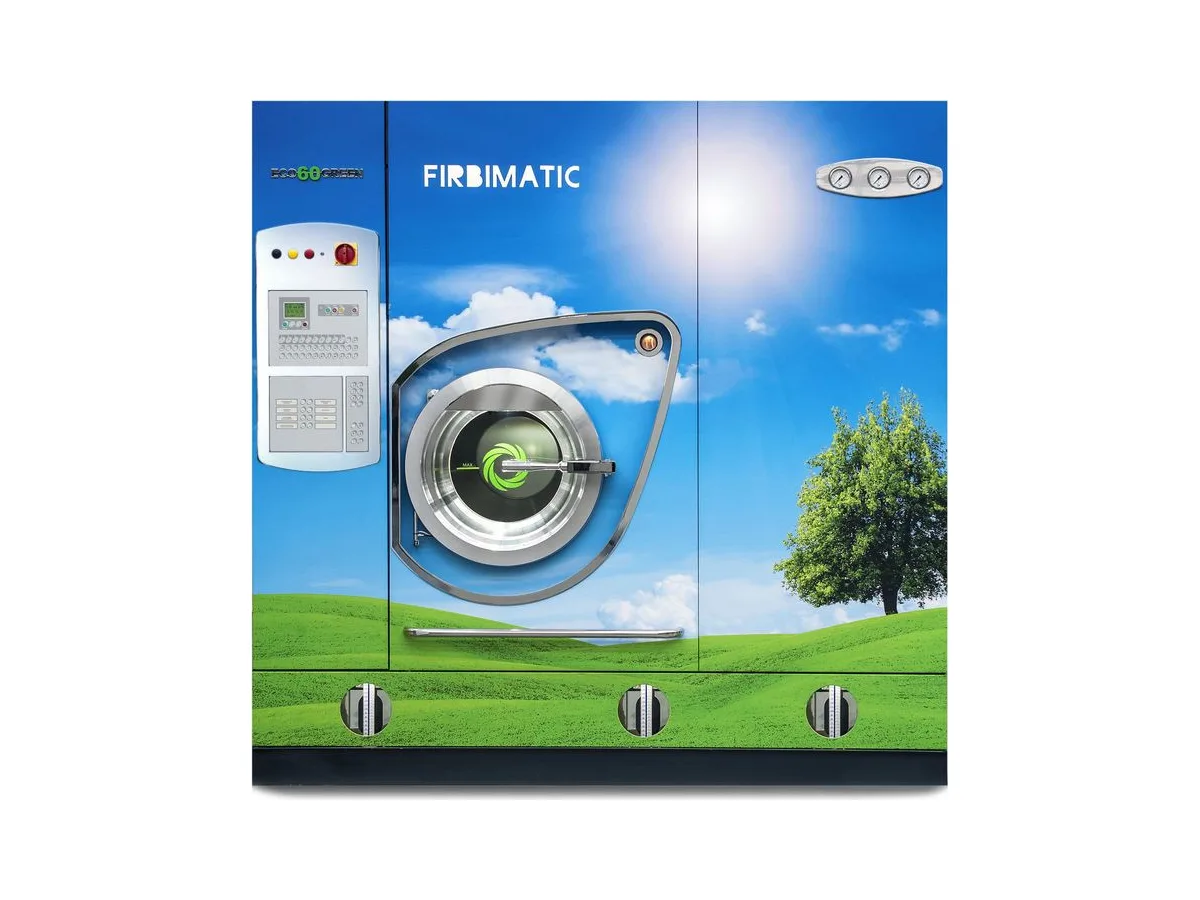
If you are new to dry cleaning, or about to buy a machine for the first time, it helps to know what happens between the moment you close the door and the moment you open it again. This article walks through a typical cycle in a modern machine, stage by stage, and explains how a closed-loop design keeps the solvent contained and reused. Where it describes specific machine features, those come from Firbimatic's own information.
Before the machine: tagging and pre-spotting
The cycle starts at the counter, not in the machine. Garments are checked, tagged and sorted, and stubborn marks are usually treated by hand with pre-spotting before anything goes in the drum. This work happens around the machine, and it has a big effect on the final result.
Loading and washing in solvent
The operator loads the garments into the drum, selects a wash program and starts the cycle. Instead of water, the garments are washed in solvent, which can be perc or an alternative solvent depending on the machine. The solvent lifts oils and soiling from the fabric, and the drum action moves the load through it.
Firbimatic machines are controlled through programs on a computer, and the company says its interfaces are designed to let operators follow each stage of cleaning. Depending on the program, the load may also receive a further bath or rinse in clean solvent before the next stage.
Extraction and drying
Once the wash is finished, the solvent is drained away and the drum spins to throw off as much liquid as possible. Firbimatic's SM series of hydrocarbon machines hangs the basket on a suspension and spins it at 800 rpm. The company says this can bring drying times down to a perc machine's level, or below.
The load is then dried with warm air. Firbimatic describes the drying stage as one of the places where a machine can gain or lose time. In its Vortex series, a purpose-built drying chamber and a carefully chosen fan position are meant to shorten drying. According to Firbimatic, more air carrying solvent vapour reaches the recovery chamber as a result, so whole cycles run shorter. The chamber is also built so that service staff can get at the heat pump and condenser coils.
Solvent recovery by distillation
During washing the solvent collects dirt, grease and other contamination. Filtration and distillation clean it up for reuse: distillation draws the solvent off and leaves the contamination behind, so the solvent is ready for another wash. Firbimatic says this reduces how much fresh solvent has to be added.
The details vary between machine families. For example:
- Firbimatic's alternative solvent machines distil under vacuum, with a dedicated pump reducing the pressure so the solvent boils at a lower temperature.
- Its Hydro-Vac system splits distillation into two stages; the earliest condensate is sent to a water separator, and probes remove any water that forms without the operator stepping in.
- On the F Series, Firbimatic lists Energy Still, which recovers heat, and Clean Still, where a pump clears the still for the operator.
How a closed-loop machine keeps solvent under control
In a closed-loop machine, the solvent never leaves the sealed system. It circulates through recycling, filtering and distilling over and over. Firbimatic describes this airtight principle as the basis of how its perc machines manage solvent. Grease and impurities come out, and clean solvent is held ready for the following wash.
Firbimatic also points to features that work as a cycle finishes and when residue is handled:
- Reducing vapour in the drum: Firbimatic says its systems bring down leftover vapour inside the drum before the door is opened. The Integrated Coalperc option uses activated carbon to catch remaining traces of perc vapour when the cycle is over.
- Handling distillation residue: the Eco System option treats the sludge left by distillation, and Clean Still spares the operator from scraping the still out by hand.
As always, operators should follow the machine manual and their state regulator's requirements when working with any solvent.
After the machine: finishing and pressing
When the cycle ends, the garments come out and go on to finishing and pressing, which happen away from the machine. This is also where you see the result: how clean the garments are, how they feel and how they smell.
Seeing it in your own shop
Every shop has a different mix of garments, space and volume, which is why Firbimatic offers its machines in several layouts, including narrow two-tank versions and Tandem configurations for higher volumes. If you would like to see how a Firbimatic machine would work in your business, get in touch with Spencer Systems to ask questions or request a quote.